This blog is in association with https://ellisjonescoach.co.uk providing access to an amazing range of presentation and performance skills training
Thank you for returning to this blog, which is now published on two platforms, Blogspot and WordPress. If you know anyone who might be interested in it but who lives in a part of the world with poor access to Google – e.g. mainland China, please send them this link:
It’s been an unusual summer. The hottest English August on record, with comparatively low-key Games in distant Rio, give or take the odd stamped foot in Moscow. We’ve had the weirdly reminiscent sights of Downing Street staff welcoming a new Tory lady boss, of the Labour Party again throwing its lot behind a shambling north London no-hoper, and of Hull City FC clambering, wide-eyed and unsteady, once more onto football’s top shelf.
Me, I went to France. Old friends invited me to stay in Cap D’Antibes, on the Côte d’Azure.They have a lovely quiet house, a few steps away from the beach where in times gone by Picasso sketched, Scott and Zelda drank, and Ernest Hemingway preened, all guests of a rich, hedonistic American couple called Gerald and Sara Murphy. Scott Fitzgerald wrote about it all in “Tender is the Night”. Another member of the group was the painter and ceramic artist Fernand Léger, now celebrated by an exuberant museum a few kilometres inland.
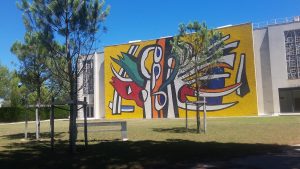
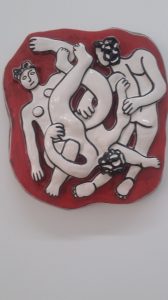
 Léger’s work is joyous: I love his wacky ceramic stuff – like the “Walking Sun”, and “The Wrestlers” – the latter perhaps hinting at party games down at the Murphies….
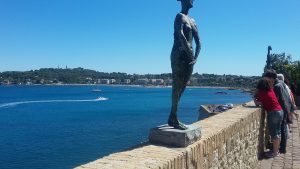
Soon after the end of the Second World War the town of Antibes presented Pablo Picasso (in self-exile from his native Spain, then still ruled by fascism) with a studio in a fine medieval tower overlooking the bay. Now the Picasso museum, it has a stunning terrace hosting work by contemporary sculptors – and it’s not hard to see why they call it the Blue Coast….
On my last evening with my friends Doug and Kate, we sipped wine in their garden while the Bastille Day fireworks crackled and whizzed across the bay in Nice. At one point the noises became very clear loud bangs, and I made a facetious remark about war breaking out. Shortly afterwards we turned on the TV news and discovered the dreadful truth about the horrible terrorist attack.
Mass murder, untold grief caused by religious bigotry – does our new PM really think it’s helpful to exhort religious parents to send their children to exclusive single-faith schools?
After a much-delayed flight back, I set about preparing to work on a drama project in Hampshire, and was rewarded by several glorious sun-filled weeks in one of England’s most idyllic counties. I stayed with my sister in the interesting market-town of Alton, full of Jane Austen associations (as indeed is my sister, a long-serving volunteer at the nearby Jane Austen museum) and on my free days we explored the country and the coast, along the way sampling cream teas, fish suppers and local ales.
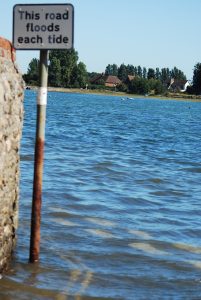
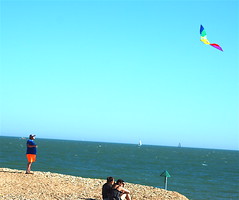
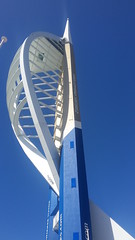
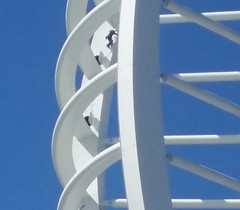
The Hampshire seaside options are rich and varied – for example, you can watch cars drown at Bosham, fly kites on Hayling island, or re-paint the Spinnaker Tower at Portsmouth….
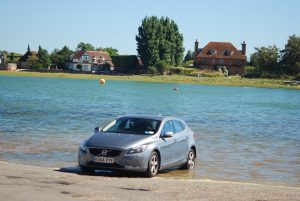
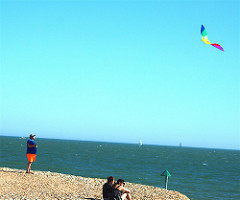

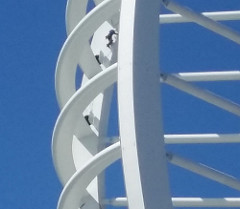
For those like me saddened by the closure (or trendy, ruinous modernisation) of so many urban pubs, it’s a joy to report that here flourish still many traditional hostelries, some hidden deep amongst inland forest hills, where it would be no surprise to find Frodo Baggins hobnobbing with Tom Bombadil over a foaming pint, or at least a poet jotting a few bucolic lines by the fireside…
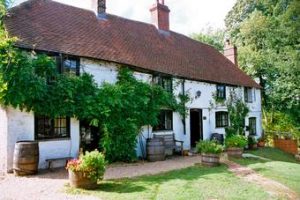
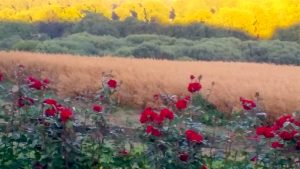
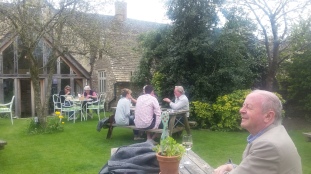
Here’s the Three Horseshoes at Elsted with its garden views of roses and wheat-fields, a secret revealed by Jane Hayward, friend and comrade from repertory days at Farnham.
The harvest evening that seemed endless then
And after, the inn where all were kind.
All strangers.
(Edward Thomas, reflecting on English country life, not by the fireside but from the trenches in Flanders in 1915.)
Many of these inns have stood since Tudor times, and this summer has brought echoes of those far-off days. We took time in Portsmouth to re-visit the Historic Dockyard, and the remarkable Mary Rose, whose timbers have now, after a nigh-on thirty year process, been wax-treated to survive for several hundreds more. Do go – if like me you have an interest in Shakespeare and his days, here’s a window into that world – or rather lots of windows – literally thousands of salvaged objects sit there as if they’d been used yesterday – clothes, gadgets, jewels, tools, weapons, all saved from a ship sunk at the Battle of the Solent on July 19, 1545. There are curiously carved cannon, ornate swords and halberds, and many long-bows as used at Agincourt, all restored with guidance from our country’s greatest long-bow expert, the gloriously nonogenerian actor Robert Hardy.
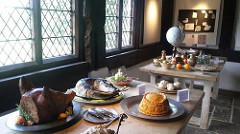
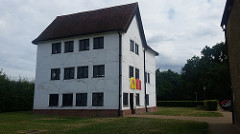
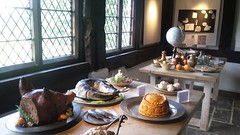
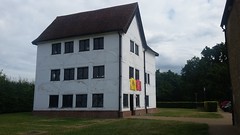
Returning to another historic county, one nearer to my east London home, my pal Robin and I went into Essex, to see the Tudor Hunting Lodge. Queen Bess’s dad Henry V111 relaxed – between bedding and beheading ladies – by hunting down stags in Epping Forest. Doubtless venison pasties featured on his table, and you can see a rather good display of prop-food at the lodge.
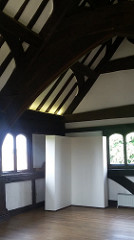
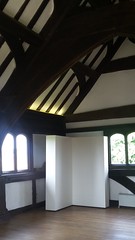
I include a picture of the stairwell, because it seems the original 16th century stairs here were used as the pattern for the staircases at the re-created Shakespeare’s Globe in 1997.
And prop-food and Elizabethan stairs take us, dear reader, back to the world of The Theatre – which is what this blog is supposed to be about. Once again it’s the time of year when I conduct New York University undergrads to London shows – and as I write this the current troupe is braving steady drizzle as Globe groundlings, watching “Macbeth”. I saw it last week – it has Ray Fearon as the Thane, with Tara Fitzgerald as the Lady, and a supporting cast including puppets. There’s a new régime at the Globe, with Emma Rice now artistic director, following several lively years running the Kneehigh company in the the West Country, promising lots of exciting new directions at Bankside. She’s already given a reportedly very funny take on “A Midsummer Night’s Dream”, featuring Helena as a chap. Quite where the current rash of onstage gender-bending has come from is difficult to nail. I reported earlier on our Michelle Terry’s impressive “Henry V” – see below for the latest manifestations.
Meanwhile, two other excursions to report. To the National Theatre, to see the Chichester Festival production of “The Seagull” – part of the Young Chekov season – with some fine acting, notably from Geoffrey Streatfeild as Trigorin, Adrian Lukis as Dorn and Jade Williams as Masha. And last week back once more into Essex, to the Queens Theatre Hornchurch. This place is worth watching – one of the very few remaining near-London regional producing houses, with high production values and a strong artistic track record.
They’ve collaborated with the New Wolsey Theatre at Ipswich to produce the first post West-End mus ical version of “Made in Dagenham”. To be honest, this was a tighter show than the West End one I reported on last year with our Gemma Arterton in the main role, by the Queens artistic director, Douglas Rintoul. There’s neat choreography, gutsy performances by a cast of actor-musicians, and the opening night was given extra resonance by the presence of some of the original Ford strikers (Hornchurch being next-door to Dagenham). It’s a show to watch, at a theatre to watch – on the London Underground (District Line) with sensible ticket prices once you get there.
ical version of “Made in Dagenham”. To be honest, this was a tighter show than the West End one I reported on last year with our Gemma Arterton in the main role, by the Queens artistic director, Douglas Rintoul. There’s neat choreography, gutsy performances by a cast of actor-musicians, and the opening night was given extra resonance by the presence of some of the original Ford strikers (Hornchurch being next-door to Dagenham). It’s a show to watch, at a theatre to watch – on the London Underground (District Line) with sensible ticket prices once you get there.Now, a heads-up for no less than THREE “King Lears”! Already in performance at Stratford is the RSC one. This is the most eccentric, as it has a man playing the King. Anthony Sher is by all accounts splendid, but I want you to go and enjoy the Unpleasant Sisters, played by two terrific Welsh actresses from my time in charge of the training at RADA, Nia Gwynne as Goneril and Kelly Williams as Reagan.
Meanwhile it won’t have escaped your notice that the great twice-Oscared Glenda Jackson has left politics to return to the boards in the title role of the same play at the Old Vic, due to open next month.
But don’t let that obscure the fact that another distinguished actress, Ursula Mohan, is re-creating the “Queen Lear” we reported on last year, and is performing with an all-new cast at the Tristram Bates Theatre in Covent Garden, starting on September 20th.
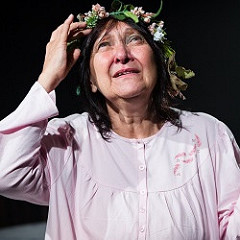
I don’t doubt that all three versions of this great work will be wonderfully revealing in different ways. But it may be worth pointing out that the London “fringe” is often the place to find pure gold, at a fraction of the prices you would would pay at the bigger houses. Connoisseurs of intriguing theatre, but especially those on a limited budget, please take note…
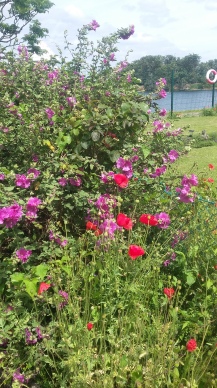
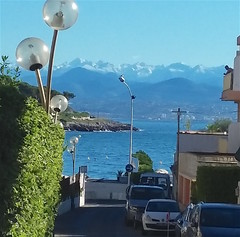
And finally, two cheering pictures taken at the end of two streets- one I have called Waltham Forest Flowers, of the blooming displays generated by the borough council on the High Street railings at the end of Coppermill Lane where I live, the other a distant view of the Alpes Maritimes taken at the end of my friends’ street at Cap d’Antibes.
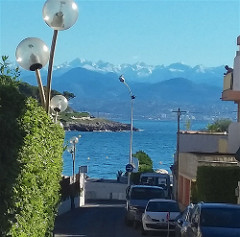 Both for now, heartening local images from within the European Union.
 At least for the next two years…
Enjoy.
IF YOU WOULD like to respond, if you disagree with any of the above, or would like to add a comment or two, I’d love to hear from you – you can do so anonymously, if you like – and I’ll happily publish your views. Just click on the word “comment” in the little box below.
This blog comes to you courtesy of www.ellisjonescoach.co.uk. If you need help with voice-training, presentation preparation, getting ready for an audition or access to classes and advice from some of the best trainers in the UK, just click on the link.
 t do festivals – I’m sure I would have loved them when I was young and green, snuggling down in the squelch, full of music and cider, carefree sex amongst the Portaloos and the rain-drenched spliff-ends
 ilway station wrapped massively in kitchen-foil!


 t of England.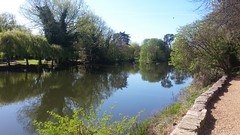


 This was “Miss Wilson’s Waterloo” with Karen Archer as the eponymous Harriette Wilson, in a one-off, specially commissioned performance for a private audience on a cruise in the North Sea, who loved it. It makes cracking, informative entertainment: a startling encounter between two people whose sexual conquests were legion. For anyone who loves amazing real-life characters in true stories from a turning point in Europe’s history – as we as a nation turn our back on that same continent – all enquiries, please, to this address.

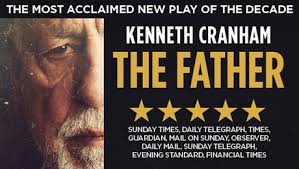
 new piece by the author of “The Father”, Florian Zeller- a play similarly translated by Christopher Hampton.”The Father”, for those who didn’t see it, is a profoundly accurate and upsetting study of a man’s life unravelling through dementia. “The Truth” is a profoundly accurate study of two marriages unravelling through infidelity – and is very, very funny! Florian is a master craftsman who writes taut, sharp dialogue in a tight skilfully-structured story-line, with perfectly-timed twists and surprises.
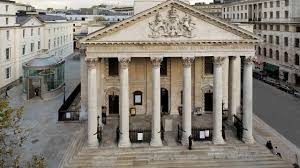
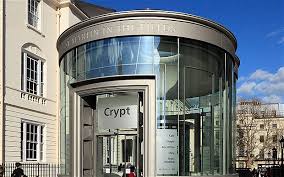
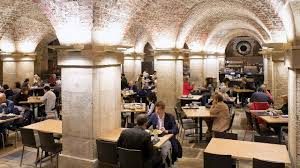 Just around the corner from Maggie Hambling’s sculpture of Oscar Wilde staring at the stars from the gutter, you can descend beneath the street to St Martin’s crypt, where you find a great gift shop, meeting rooms, chapel, an art gallery – and a large self-service, licensed restaurant serving good food at reasonable prices, an increasingly rare phenomenon in theatre-land.
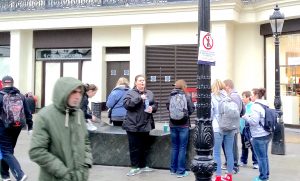 If you would seek Oscar’s monument…..look under the cardboard coffee cups.
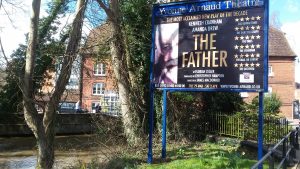 ord, where the Yvonne Arnaud Theatre sits beside a tumbling mill-race. I first visited a theatre in the riverside car-park in this town in the early 60s, on a visit to the famous Century Theatre, which was a touring theatre building. Yes, building. This extraordinary phenomenon toured the towns and cities of post-war England, in Guildford keeping the creative flame alight while funds were raised to replace the burned out repertory theatre in North St. The Yvonne Arnaud Theatre was completed in 1965.
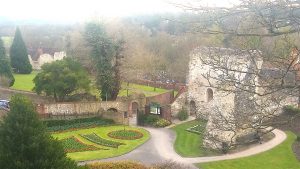 We had a great week as spring began cautiously (and mistily) to arrive. Back in 1066 William the Conqueror spotted the potential of Guildford as a regional centre, and built a tidy castle up on the top of a hill overlooking the town, which he clearly meant to last. And last it did, and it’s now surrounded by lovely gardens and great views across Surrey.
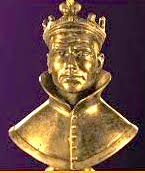 The play itself lost out to “Hangmen” in the Best New Play list, but then came the keenly awaited presentation of the Best Male Actor award. There had been feverish speculation in the media about a head-to-head confrontation between Benedict Cumberbatch for “Hamlet” and Mark Rylance for “Farinelli and the King”.
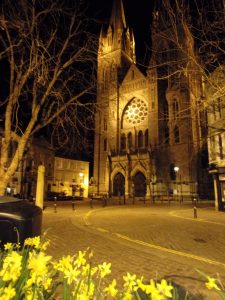
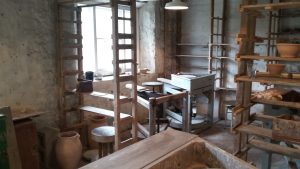
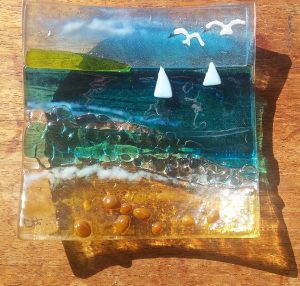
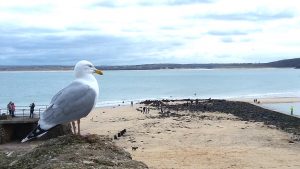 he last century, the Cornish coast was a magnet for artists. Whether the sun shines or not, the light has a special quality, the air salty and sharp. And when it’s bright the sea and sky are boldly blue, with sub-tropical trees deeply green beside the flinty grey and white of the buildings. Although the town was enjoying a healthy crop of tourists, I found the (still operational) Bernard Leach pottery almost deserted, and wandered in the quiet of Barbara Hepworth’s sculpture garden.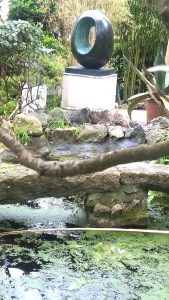
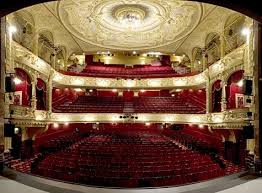 Then back home, and a week’s nice easy commute to Richmond Theatre – another small piece of fine craft-work, this time by the great Victorian architect, Frank Matcham. Size is of course relative, Richmond Theatre isn’tthat small – about 800 seats – but it’s modest alongside his famous blockbusters like The London Palladium or our next stunning venue, The Theatre Royal Newcastle. This glorious palace recently had a £4.75m refurbishment, and it feels like it – it’s terrific to work in or to watch shows in, and the locals are rightly very proud of it.
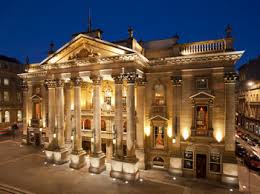 (Picture: Ents24.com)
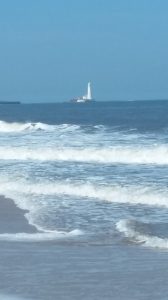
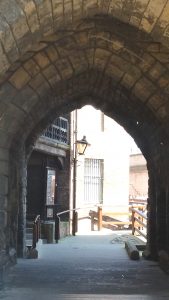
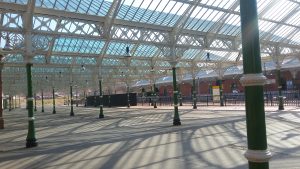
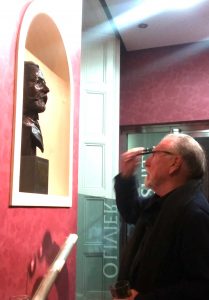
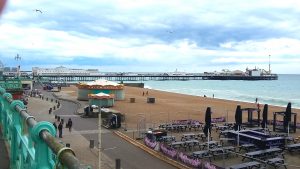
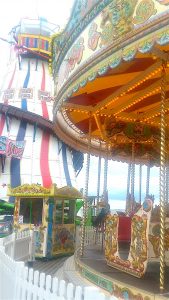 Yet another fine Victorian Theatre Royal, in a town famous for its mix of elegance and sleaze, the opulent and the tacky. You can find bargains in the Lanes, eat fish and chips sometimes almost as good as those in the north-east, or pick your way through hordes of French students to inspect the Pier, which is currently up for sale should you have millions spare to invest in something more adventurous than failing retail stores or dodgy banks…
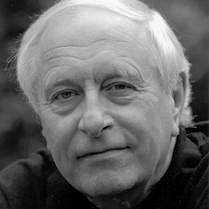 with a gift for bringing cheer, who when they turn up in your thoughts, make you smile.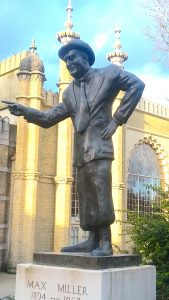
 And talking of whom, here is one of mine, the remarkably talented Lin Li, known to her English pals as Milly – who on Wednesday graced once more the UK Chinese Students Association New Year Gala, this time at the O2 Arena, with a bravura display of Guzheng music, accompanied on drums by Tong Jiaxing – the musicians post-grads at King’s London and Oxford Universities respectively. If you don’t know what a guzheng sounds like, at the bottom of the page there’s a link to a Youtube video of Milly playing with a young orchestra in China.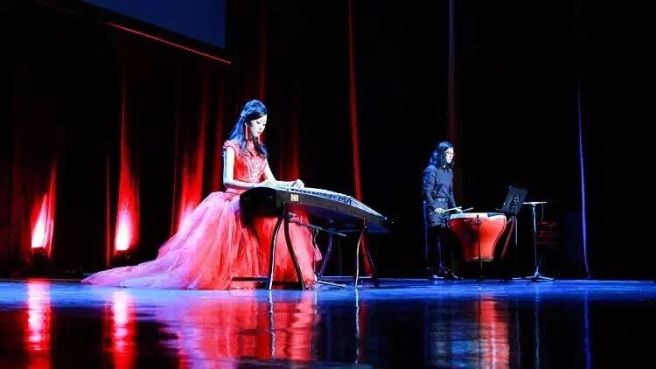

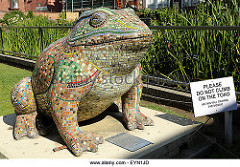


 Léger’s work is joyous: I love his wacky ceramic stuff – like the “Walking Sun”, and “The Wrestlers” – the latter perhaps hinting at party games down at the Murphies….




 ical version of “Made in Dagenham”. To be honest, this was a tighter show than the West End one I reported on last year with our Gemma Arterton in the main role, by the Queens artistic director, Douglas Rintoul. There’s neat choreography, gutsy performances by a cast of actor-musicians, and the opening night was given extra resonance by the presence of some of the original Ford strikers (Hornchurch being next-door to Dagenham). It’s a show to watch, at a theatre to watch – on the London Underground (District Line) with sensible ticket prices once you get there.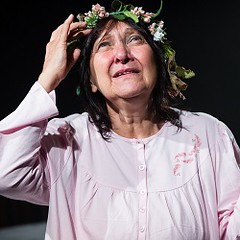
 Both for now, heartening local images from within the European Union.
 At least for the next two years…
